I came across the phrase “January in Japan” on booktok or somewhere online (as these things usually are), and it stayed with me. Most of it was tied to Japanese literature: quiet novels, reflective reads, books that feel best suited to slow days and long evenings. It wasn’t a genre so much as a feeling. A temperament.
And if this structure works for books, I figured it could work for adaptations too.
That thought became this newsletter.
What follows isn’t a list I’ve “completed” or a ranking of favourites. It’s a framework: 31 Japanese book-to-screen adaptations, one per day. Some are films, some are series. Some are anime, some are live-action. All of them originate from novels, manga, or short stories, and all of them translate literature into something visual, emotional, and lived-in.
Okay, enough talk. Let’s begin!
(for the sake of my sanity, I’ve arranged them alphabetically)
January in Japan
the adaptation archive · 1 Jan

31 Japanese book-to-screen adaptations (in two parts)
And now, the second half of January in Japan.
- Lonely Castle in the Mirror | 2022 | 116 minDirected by: Keiichi Hara
Genre: Animation, Fantasy, Drama
Lonely Castle in the Mirror, adapted from Mizuki Tsujimura’s novel, unfolds through seven emotionally withdrawn teenagers who find themselves summoned to a mysterious castle accessible through their bedroom mirrors. As they search for a hidden key that promises to grant one wish, the story gently unravels themes of isolation, bullying, and resilience.
- Maborosi | 1995 | 110 minDirected by: Hirokazu Kore-edaGenre: Drama
Maborosi, adapted from Teru Miyamoto’s short story, dwells on a young widow struggling to understand her husband’s sudden, inexplicable death. Refusing easy answers or emotional release, the film observes grief as something that lingers in everyday gestures, silences, and routines.
- Memories of Tomorrow | 2006 | 122 minDirected by: Yukihiko Tsutsumi
Genre: Drama
Memories of Tomorrow, adapted from Hiroshi Ogiwara’s novel, moves through a successful middle-aged man confronting the early onset of Alzheimer’s disease as memory begins to erode his sense of self. The film examines this decline with a measured approach, focusing on everyday disorientation rather than spectacle, and on how illness reshapes relationships.
- Paprika | 2006 | 90 minDirected by: Satoshi Kon
Genre: Adult Animation, Sci-Fi, Psychological
Paprika, adapted from Yasutaka Tsutsui’s novel, explores a near future where therapists can enter patients’ dreams through experimental technology. As the boundary between dream and waking life collapses, the film spirals into a vivid meditation on identity, desire, and the subconscious.
- Perfect Blue | 1997 | 82 minDirected by: Satoshi Kon
Genre: Adult Animation, Psychological Thriller
Perfect Blue, adapted from Yoshikazu Takeuchi’s novel, centers on a former pop idol whose attempt to reinvent herself as an actress leads to a gradual collapse of identity. As reality and performance begin to mirror each other, the film traces how obsession, surveillance, and expectation fracture the self, leaving its protagonist increasingly isolated within her own image.
- Ran | 1985 | 160 minDirected by: Akira Kurosawa
Genre: Epic, Action, Period Drama
Ran, inspired by William Shakespeare’s King Lear, reimagines a tale of familial betrayal and pride within the brutal landscape of feudal Japan. As a powerful warlord divides his kingdom among his sons, loyalty gives way to ambition and violence. Vast in scale yet intimate in its despair, the film traces the slow, inevitable unraveling of authority into madness and ruin.
- Sweet Bean | 2015 | 113 minDirected by: Naomi Kawase
Genre: Drama
Sweet Bean, adapted from Durian Sukegawa’s novel, brings together a taciturn shop owner and an elderly woman whose gift for making sweet red bean paste carries the weight of an unspoken past. Through shared routines and gentle conversation, the film locates tenderness in patience, listening, and care. Unassuming and deeply humane, it suggests that connection often arrives through the smallest, most ordinary acts.
- The Girl Who Leapt Through Time | 2006 | 98 minDirected by: Mamoru Hosoda
Genre: Animation, Sci-Fi, Coming-of-Age
The Girl Who Leapt Through Time, adapted from Yasutaka Tsutsui’s novel, imagines adolescence through the lens of time travel, granting a high school girl the power to leap backward and revise small embarrassments and everyday missteps. With each jump introducing unintended consequences, the film gradually recasts time travel as a coming-of-age metaphor—about accepting that some moments resist correction, and that moving forward can be an act of courage.
*There are quite a few adaptations of this, but if you’re in the mood for live action, the 1983 one directed by Nobuhiko Obayashi is probably your best bet, imho.
- The Last 10 Years | 2022 | 124 minDirected by: Michihito Fujii
Genre: Romance, Drama
The Last 10 Years, adapted from Ruka Kosaka’s novel, is a devastating love story shaped by the certainty of limited time. Centered on a young woman living with a terminal illness, the film resists melodrama, focusing instead on routine, restraint, and emotional economy. Like much reflective Japanese fiction, its power lies not in the weight of tragedy itself, but in the honesty with which intimacy is allowed to exist alongside it.
- The Miracles of the Namiya General Store | 2017 | 129 minDirected by: Ryuichi Hiroki
Genre: Fantasy, Drama
The Miracles of the Namiya General Store, adapted from Keigo Higashino’s eponymous novel, unfolds around a small, shuttered shop where letters seeking advice slip across time. As strangers respond to questions from the past, the film reveals how regrets echo, kindness travels, and guidance often returns to the giver.
*It also has a Chinese adaptation starring Jackie Chan. And on a completely personal note, this is my favourite Higashino—if you ever pick up the book, I’d genuinely love to know what you think.
- The Night Is Short, Walk On Girl | 2017 | 93 minDirected by: Masaaki Yuasa
Genre: Animation, Rom-Com, Fantasy
The Night Is Short, Walk On Girl, adapted from Tomihiko Morimi’s novel, unfolds over a single, surreal night in Kyoto as a young woman wanders from bar to book fair to chance encounter, blissfully unaware she’s being followed by a smitten senior. Playful and episodic, the film turns coincidence into choreography, capturing youth as a state of motion, where desire, curiosity, and misadventure blur into one long, luminous night.
- The Professor’s Beloved Equation | 2006 | 117 minDirected by: Takashi Koizumi
Genre: Drama
The Professor’s Beloved Equation, adapted from Yoko Ogawa’s novel, brings together a brilliant mathematician whose memory resets every eighty minutes and the housekeeper who learns to meet him within that fragile rhythm. As numbers become points of stability in a life without continuity, the film considers memory, intimacy, and unconventional forms of family. Gentle and precise, it suggests that connection does not depend on permanence, but presence.
- The Twilight Samurai | 2002 | 129 minDirected by: Yoji Yamada
Genre: Historical Drama, Romance
The Twilight Samurai, inspired by Shuhei Fujisawa’s short story The Bamboo Sword, centers on a low-ranking samurai whose priorities lie less in status or glory than in raising his daughters. Set at the waning edge of the Edo period, the film pares away romanticised heroism, giving its attention to domestic responsibility and uncelebrated dignity. In doing so, it redefines honor not as spectacle, but as the choices made in ordinary, unseen moments.
- There Is No Lid on the Sea | 2015 | 84 minDirected by: Keisuke Toyoshima
Genre: Drama
There Is No Lid on the Sea, adapted from Banana Yoshimoto’s short story, focuses on two young women who open a shaved ice shop by the sea, each carrying an unspoken grief. As days pass in repetition and quiet companionship, the film lets loss surface gently—through memory, weather, and pauses rather than confrontation.
- True Mothers | 2020 | 140 minDirected by: Naomi Kawase
Genre: Drama
True Mothers, adapted from Mizuki Tsujimura’s novel, focuses on two women connected through an adoption that slowly reveals its emotional cost on both sides. As past and present intertwine, the film approaches motherhood not as a singular role, but as a web of love, loss, and responsibility.
- Whisper of the Heart | 1995 | 111 minDirected by: Yoshifumi Kondo
Genre: Animation, Coming-of-Age
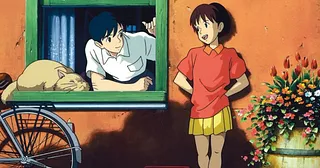
Whisper of the Heart, adapted from Aoi Hiiragi’s manga, moves through the inner life of a quietly restless middle school girl who begins questioning who she is and what she might become. Sparked by books borrowed from the same mysterious reader and an unexpected friendship, the film treats creativity as something tentative and unfinished. Gentle and deeply sincere, it captures coming of age not as transformation, but as the first, uncertain decision to try.
*My ABSOLUTE favourite Ghibli film.
And that’s it.
Thanks for making it to the end.
Whether you watch one, a handful, or all thirty-one—
I hope something here makes you glad you found this newsletter.
— Piggy x
If this space has given you a TBR, a watchlist, or a moment of curiosity, and you’d like to support my work…
…comment, share, subscribe, buy me a coffee, or shop my affiliate links.
You can also follow the adaptation archive on Instagram & Pinterest