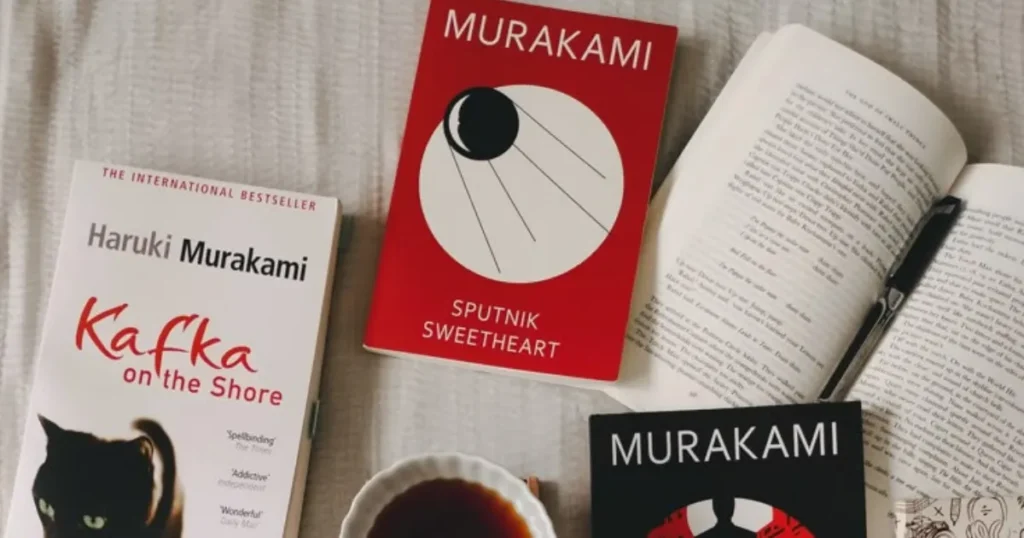
If I were to shout Japanese Literature into a crowded room, chances are most people (and their grandmothers) would shout back Haruki Murakami.
That’s not to say Japan doesn’t have other deeply beloved, widely read authors. Keigo Higashino (my personal favourite) has built an entire universe of morally tangled crime fiction, and Kazuo Ishiguro is, arguably, the better (literarily respectable?) read—measured, devastating, Nobel-stamped. But Murakami? Murakami is the name that travels. The name that trends.
Cult-like recognition.
And with Norwegian Wood and Kafka on the Shore still holding readers in a chokehold decades later, the fixation feels… justified?
I’ve read a few Murakami novels myself, but somehow (and this might be sacrilege), it’s just not my lane. Still, his cultural gravity is undeniable.
What fascinates me most is how Murakami’s stories, often interior, ambiguous, and resistant to explanation, have been reimagined through global cinema. Across countries, languages, and styles, filmmakers have attempted the impossible: translating his quiet loneliness, surreal slips, and emotional pauses into moving images.
So, for the fourth issue of January in Japan, I’ve curated Murakami’s screen adaptations, arranged by release year, starting with the most recent.
- After the Quake | 2025 | 132 minDirected by: Tsuyoshi InoueGenre: Drama
After the Quake, adapted from Haruki Murakami’s short story collection, After the Quake, unfolds in the emotional aftermath of the 1995 Kobe earthquake. Rather than depicting the disaster itself, the film focuses on characters living at a psychic distance from the event—disconnected, drifting, and quietly altered. Episodic and understated, it treats catastrophe as something that lingers internally, reshaping lives in ways that are difficult to name.
- Blind Willow, Sleeping Woman | 2022 | 105 minDirected by: Pierre FöldesGenre: Animated Drama
Adapted from multiple Murakami short stories, Blind Willow, Sleeping Woman unfolds as an animated collage of disconnected lives in post-earthquake Tokyo. Cats speak, frogs argue with men, and loneliness hums beneath every interaction. Rather than telling a single story, the film drifts, mirroring Murakami’s own narrative logic, where meaning emerges through mood, repetition, and emotional resonance.
- Drive My Car | 2021 | 179 minDirected by: Ryūsuke HamaguchiGenre: Psychological Drama
Based on a short story from the collection Men Without Women, Drive My Car expands Murakami’s minimalism into a slow, immersive meditation on grief, art, and communication. A theatre director and his chauffeur form an unlikely bond; structured around long conversations and quiet drives, the film allows loss to surface gradually, through pauses and repetition. Patient and emotionally exacting, it reflects on how people carry pain without ever fully articulating it.
- Burning | 2018 | 148 minDirected by: Lee Chang-dongGenre: Psychological Thriller, Drama
Burning, inspired by Haruki Murakami’s short story “Barn Burning,” follows a young man drawn into a tense, ambiguous relationship with a woman and a wealthy stranger. Expanding Murakami’s premise into a slow-burn psychological mystery, the film interrogates class, desire, and the violence of uncertainty. Its power lies in what remains unresolved, hovering just beneath the surface.
- Hanalei Bay | 2018 | 97 minDirected by: Daishi MatsunagaGenre: Drama
Based on Murakami’s short story of the same name, Hanalei Bay follows a mother returning to the Hawaiian beach where her son drowned years earlier. Grief here is not loud or dramatic; it’s cyclical, restrained, and unresolved. Matsunaga allows memory and absence to occupy the frame, echoing Murakami’s quiet emotional weight.
- Norwegian Wood | 2010 | 133 minDirected by: Tran Anh HùngGenre: Romance, Drama
Murakami’s most famous novel finds a visually lush but emotionally restrained adaptation in Norwegian Wood. Set in 1960s Tokyo, it traces love, loss, and mental health through the lens of youth. Stripped of surrealism, the film leans into melancholy realism—explaining both its wide appeal and the fierce debates around its faithfulness.
- Tony Takitani | 2004 | 77 minDirected by: Jun IchikawaGenre: Drama
Tony Takitani, adapted from Haruki Murakami’s short story, follows a solitary illustrator whose life is shaped by emotional detachment and routine. When he marries, connection arrives briefly, only to leave a deeper absence behind. Minimalist and precise, the film reflects on loneliness not as tragedy, but as a condition learned over time. This portrait of solitude doesn’t interpret Murakami; it inhabits him.
- Hear the Song of the Wind | 1981 | 98 minDirected by: Kazuki ŌmoriGenre: Drama
Adapted from Murakami’s debut novel, this early film captures the aimless days of a young man drifting through summer conversations, bars, and half-formed thoughts. Rough and uneven, it remains an important artifact—both of Murakami’s beginnings and of Japanese cinema cautiously grappling with his voice.
Seen chronologically, these adaptations chart less a definitive interpretation than a series of attempts—earnest, ambitious, occasionally flawed—to capture something deliberately elusive, which may be the most Murakami outcome of all.
Whether or not his writing is your lane, his afterimage is difficult to escape, and cinema, it seems, keeps trying anyway.
See you next newsletter.
— Piggy x
If this space has given you a TBR, a watchlist, or a moment of curiosity, and you’d like to support my work…
…comment, share, subscribe, buy me a coffee, or shop my affiliate links.
You can also follow the adaptation archive on Instagram & Pinterest